
In the rapidly evolving landscape of metabolic research, few compounds have generated as much scientific interest as retatrutide (LY3437943). As laboratories across the UK scale up their investigations into this pioneering triple-hormone receptor agonist, one of the most frequent procurement questions we receive is: should researchers choose a retatrutide 60mg vial or a retatrutide 30mg vial for their studies?
This comprehensive guide breaks down the key differences between these two research formats, helping laboratory managers and principal investigators make data-driven decisions about which size best suits their experimental protocols, budget, and research objectives.
Disclaimer: All information presented in this article is strictly for educational and laboratory research purposes. Retatrutide is a research compound and is not approved for human or veterinary consumption.
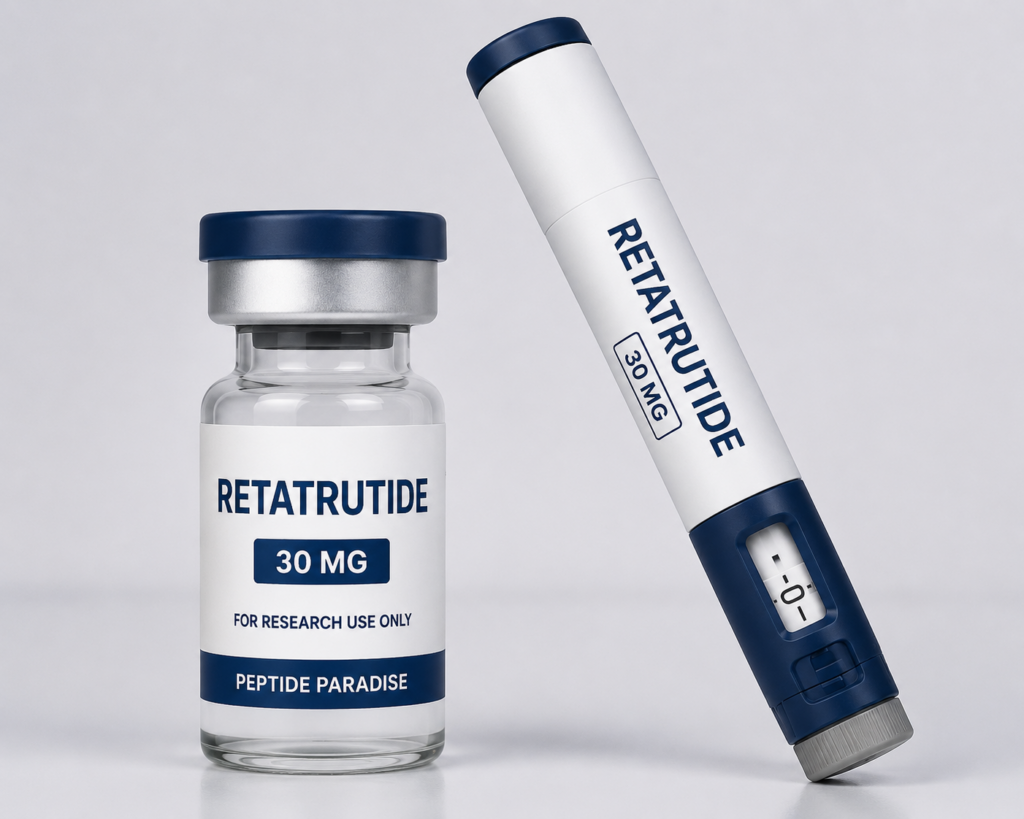
Understanding Retatrutide: A Brief Scientific Overview on 30mg of retatrutide
Before comparing vial sizes, it is essential to understand why this compound has become a cornerstone of modern metabolic research. Retatrutide is a single-molecule triple receptor agonist that simultaneously targets the glucose-dependent insulinotropic polypeptide (GIP), glucagon-like peptide-1 (GLP-1), and glucagon (GCG) receptors.
According to <a href=”https://clinicaltrials.gov/study/NCT04881760″ target=”_blank” rel=”noopener noreferrer”>published clinical trial data</a>, this unique poly-pharmacological profile has demonstrated significant potential in preclinical and clinical research models investigating energy expenditure, glycaemic regulation, and body-weight modulation. The compound’s ability to engage three distinct hormonal pathways simultaneously sets it apart from earlier single- or dual-agonist research peptides.
For laboratories sourcing high-purity retatrutide, the choice between vial sizes is not just about quantity—it is about optimizing experimental design, minimizing waste, and ensuring batch consistency throughout the study period.
The Retatrutide 30mg Vial: Ideal for Pilot Studies and Short-Term Protocols
The retatrutide 30mg vial is the preferred entry point for many research facilities, particularly those initiating new investigative protocols or conducting preliminary feasibility studies. Here is why laboratories frequently choose this format:
- Pilot Study Optimization: When researchers are testing new reconstitution ratios, exploring dose-response relationships, or validating analytical methods, the 30mg vial provides sufficient material for multiple experimental runs without committing to a larger inventory.
- Reduced Waste Risk: For laboratories with limited storage capacity or those conducting short-term studies (typically 2–4 weeks), the 30mg format minimizes the risk of compound degradation before use. Once reconstituted, retatrutide must be stored at 2–8°C and used within a specific stability window.
- Budget Flexibility: Research facilities operating under tight grant cycles or quarterly budgets often find the lower upfront cost of the 30mg vial more manageable, allowing them to allocate funds across multiple research priorities.
- Method Validation: Before scaling up to larger studies, many principal investigators use the 30mg vial to validate their laboratory protocols, ensuring that reconstitution, storage, and administration procedures are optimized before committing to larger quantities.
The retatrutide 30mg vial is particularly popular among university research labs, contract research organizations (CROs) conducting feasibility studies, and facilities exploring novel applications of the compound in metabolic pathway analysis.
The Retatrutide 60mg Vial: The Preferred Choice for Long-Term Research
For laboratories conducting extended, multi-week research protocols, the retatrutide 60mg vial offers distinct advantages that make it the preferred choice for serious scientific investigations. Here is why advanced research facilities gravitate toward this format:
- Superior Cost-Per-Mg Value: When calculating the true cost of research, the 60mg vial typically offers a more favorable cost-per-milligram ratio compared to purchasing multiple 30mg vials. This is particularly important for laboratories running longitudinal studies that require consistent compound availability over 8–12 weeks.
- Batch Consistency: One of the most critical factors in reproducible research is batch consistency. By sourcing a single 60mg vial, researchers eliminate the potential variability that can occur when using multiple smaller vials from different production batches. This is crucial for studies requiring precise, reproducible dosing across the entire experimental timeline.
- Reduced Handling Frequency: Every time a researcher opens a new vial, there is a potential risk of contamination or handling error. The 60mg vial reduces the frequency of vial access, minimizing these risks and streamlining laboratory workflows.
- Extended Study Duration: For research protocols requiring 6–12 weeks of consistent administration, the 60mg vial provides sufficient material to complete the study without interruption. This eliminates the need to reorder mid-study, which can introduce batch variability and disrupt experimental continuity.
- High-Throughput Research: Laboratories conducting multiple parallel experiments or working with larger research model cohorts often find that the 60mg vial provides the necessary volume to support their throughput requirements without frequent reordering.
The 60mg retatrutide vial is the standard choice for pharmaceutical research organizations, advanced academic laboratories, and contract research facilities conducting GLP-compliant studies.
Reconstitution Math: 30mg vs 60mg Vial Comparison
One of the most practical considerations when choosing between vial sizes is the reconstitution process. Proper reconstitution is critical for ensuring accurate dosing and maintaining compound stability. Let’s compare the reconstitution math for both formats.
Retatrutide 30mg Vial Reconstitution:
For a standard research concentration of 2mg/mL:
- Add 15mL of sterile bacteriostatic water to the 30mg vial
- Each 1mL drawn from the vial contains 2mg of retatrutide
- For a 2mg research dose, draw 1mL
- For a 4mg research dose, draw 2mL
For a higher concentration of 5mg/mL:
- Add 6mL of sterile bacteriostatic water to the 30mg vial
- Each 1mL drawn from the vial contains 5mg of retatrutide
- For a 5mg research dose, draw 1mL
- For a 10mg research dose, draw 2mL
Retatrutide 60mg Vial Reconstitution:
For the same 2mg/mL concentration:
- Add 30mL of sterile bacteriostatic water to the 60mg vial
- Each 1mL drawn from the vial contains 2mg of retatrutide
- For a 2mg research dose, draw 1mL
- For a 4mg research dose, draw 2mL
For the same 5mg/mL concentration:
- Add 12mL of sterile bacteriostatic water to the 60mg vial
- Each 1mL drawn from the vial contains 5mg of retatrutide
- For a 5mg research dose, draw 1mL
- For a 10mg research dose, draw 2mL
Key Insight: The reconstitution math is identical in terms of ratios. The only difference is the total volume of bacteriostatic water required. This means that researchers can use the same dosing protocols regardless of vial size, making it easy to scale studies up or down based on availability.
Storage Considerations: 30mg vs 60mg
Proper storage is critical for maintaining the structural integrity and biological activity of retatrutide. Both the 30mg and 60mg vials require identical storage conditions:
- Lyophilised (unreconstituted) powder: Store at 2–8°C (refrigerated). Do not freeze. Protect from light.
- Reconstituted solution: Store at 2–8°C (refrigerated). Use within the stability window specified in the product documentation (typically 14–28 days, depending on concentration).
- Shipping: Both formats should be dispatched with cold packs via tracked, expedited delivery to maintain temperature integrity during transit.
The main storage consideration is shelf life after reconstitution. If your research protocol requires only a small amount of reconstituted solution, the 30mg vial may be preferable to avoid waste. However, if your protocol requires consistent access over several weeks, the 60mg vial provides better value and reduces the risk of running out mid-study.
Which Vial Size is Right for Your Research?
The decision between a retatrutide 60mg vial and a retatrutide 30mg vial ultimately depends on your specific research requirements. Here is a quick decision framework:
Choose the Retatrutide 30mg vial if:
- You are conducting pilot studies or method validation
- Your research protocol is short-term (2–4 weeks)
- You have limited storage capacity
- You are working within a tight budget cycle
- You need to test multiple reconstitution ratios
Choose the retatrutide 60mg vial if:
- You are conducting long-term, multi-week research protocols (6–12 weeks)
- Batch consistency is critical for your study
- You want the best cost-per-mg value
- You are running high-throughput experiments with multiple research models
- You want to minimize handling frequency and contamination risk
Source Premium Retatrutide Vials with Confidence
Whether you choose the retatrutide 60mg vial for long-term research or the retatrutide 30mg vial for pilot studies, the most critical factor is sourcing from a reputable UK supplier that provides batch-specific Certificates of Analysis (CoA), verified purity (>99%), and secure, temperature-controlled delivery.
FREQUENTLY ASKED QUESTIONS
Question 1: What is the difference between a retatrutide 60mg vial and a retatrutide 30mg vial?
Answer 1: The primary difference is the quantity of lyophilised retatrutide powder. The 60mg vial contains twice the amount of compound compared to the 30mg vial, making it ideal for long-term research protocols, while the 30mg vial is better suited for pilot studies and short-term experiments.
Question 2: Which retatrutide vial size offers better value for research?
Answer 2: The retatrutide 60mg vial typically offers better cost-per-mg value for laboratories conducting extended research protocols. However, the 30mg vial may be more cost-effective for short-term studies or pilot experiments where minimizing waste is a priority.
Question 3: How do I reconstitute a retatrutide 60mg vial?
Answer 3: To reconstitute a retatrutide 60mg vial, add sterile bacteriostatic water based on your target concentration. For a 2mg/mL solution, add 30mL of bacteriostatic water. For a 5mg/mL solution, add 12mL. Always inject the water slowly down the side of the vial and gently swirl (do not shake) until fully dissolved.
Question 4: How long does reconstituted retatrutide last in the refrigerator?
Answer 4: Once reconstituted, retatrutide should be stored at 2–8°C and used within the stability window specified in the product documentation, typically 14–28 days depending on concentration. Always follow your institution’s standard operating procedures for peptide storage.
Question 5: Can I use both 30mg and 60mg retatrutide vials in the same research study?
Answer 5: While technically possible, it is not recommended for studies requiring strict batch consistency. Using vials from different production batches can introduce variability. For reproducible results, it is best to source sufficient quantity from a single batch for the entire study duration.
Question 6: Where can I buy retatrutide vials for laboratory research in the UK?
Answer 6: You can purchase premium, research-grade retatrutide vials from reputable UK suppliers such as RetatrutideCost.co.uk. Ensure the supplier provides batch-specific Certificates of Analysis (CoA), verified purity (>99%), and secure, temperature-controlled delivery. 30mg of retatrutide
Question 7: Is retatrutide approved for human use?
Answer 7: No. Retatrutide is a research compound supplied strictly for in vitro and in vivo laboratory research and development purposes. It is not approved by the MHRA or FDA for human or veterinary consumption. All handling should be conducted by qualified research professionals in controlled environments.